Pair of French mounted Louis XVI potpourri containers

Pair of French mounted Louis XVI potpourri containers
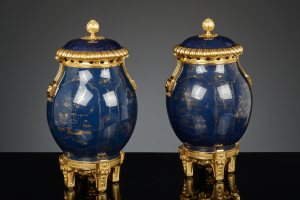
A pair of French mounted potpourri pots with mounted Japanese lacquerware maki-e bowls. The bowls are mounted with their openings facing each other, thus together forming a single vessel. The two lacquerware halves are separated by an openwork gilt bronze band, allowing the fragrance from the container to spread through the room. The two handles on opposite sides of the container rise from this band, each featuring a ram’s head mounted at the base. Festoons are suspended between the ram’s heads, draping across the lower bowl. At the top, the lacquerware is crowned with an openwork lid with a pine cone. The vessels each stand upon a tall, round foot that flares towards the base, which stands atop a square plinth.
Potpourri
Potpourri pots appeared in France from the seventeenth century onwards, and became popular throughout Western Europe in the course of the eighteenth century. Potpourri vessels were filled with fragrant dried petals and/or herbs mixed with some salt. Because the resulting mixture was visually unattractive (potpourri literally means “rotten pot”), the vessels made to contain it usually had a lid. The contents’ fragrances could then permeate the room through holes in the lid or openings in the pot’s metal rim. The pots themselves were lavishly ornamented to serve as eye-catching centrepieces on the mantel above the fireplace, the heat from which further helped the fragrances spread around the room.
Chinese and Japanese luxury objects with bronze frames were particularly popular, and this pair stands as an excellent example. “The French adore Oriental culture, but often make additions to it,” wrote Jean Baptiste de Voyer, Marquis of Argenson, in his Chinese letters around 1740. Oriental porcelain and lacquerware inspired the Parisian marchand-merciers, who sought to provide their famous clientele with the latest novelties, such as mounted objects. When Eastern wares arrived in Europe, the rarest pieces were immediately processed and fitted with fire-gilt bronze. These pieces were the very height of fashion in the latter half of the eighteenth century, and were supplied by such marchand-merciers as Lazare-Duvaux.
- Provenance
- Salomon Stodel, ca. 1990
Private collection of Paulus van Pauwvliet, Amsterdam
Private collection of Eugen Albert (1934 - 2024), purchased by him in 2012. - Period
- ca. 1780
- Material
- Japanese lacquerware bowls, fire-gilt bronze
- Dimensions
- 24.5 cm
Global shipping available
You might also like