Piemontese ensemble of two armchairs and two sofas
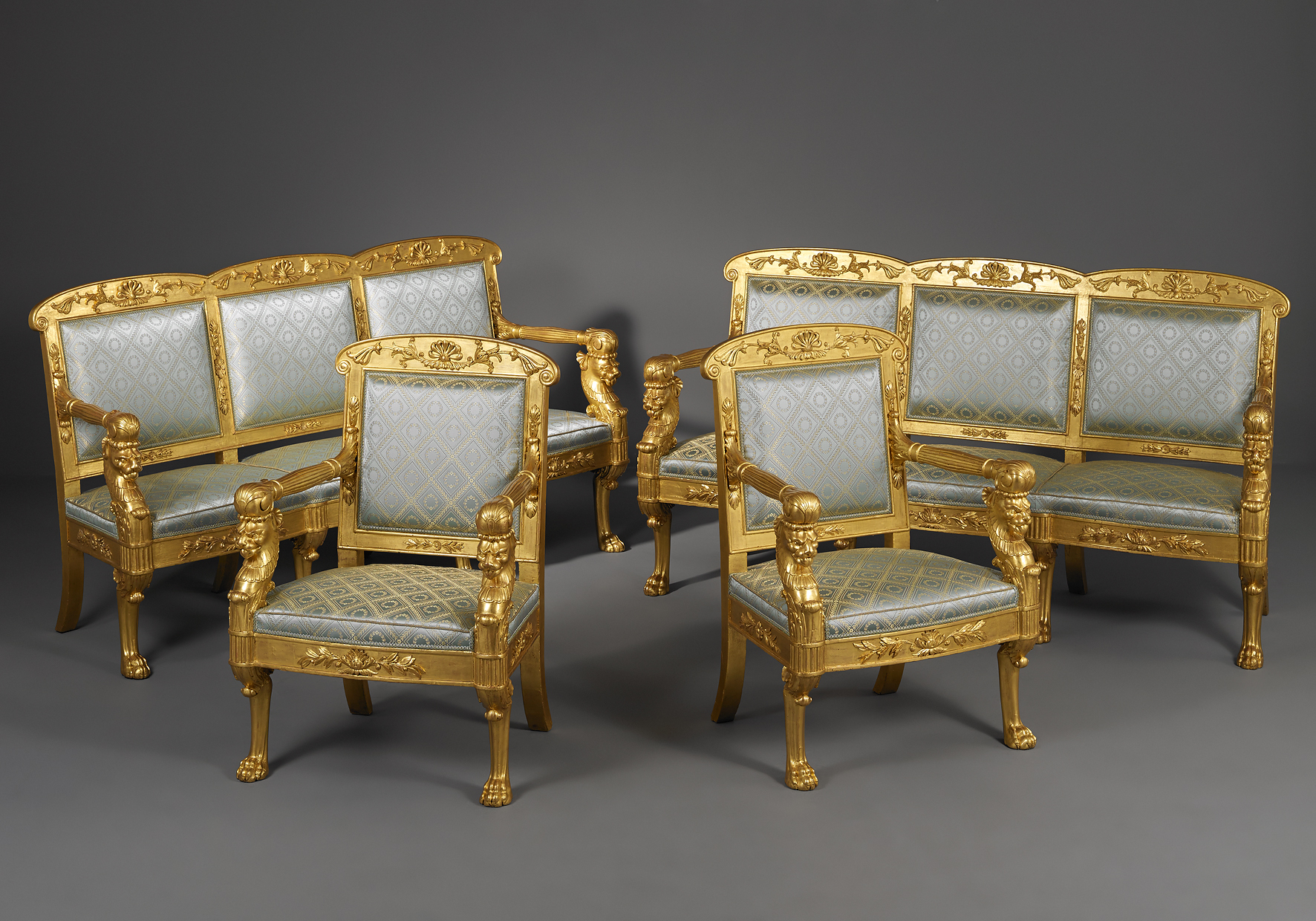
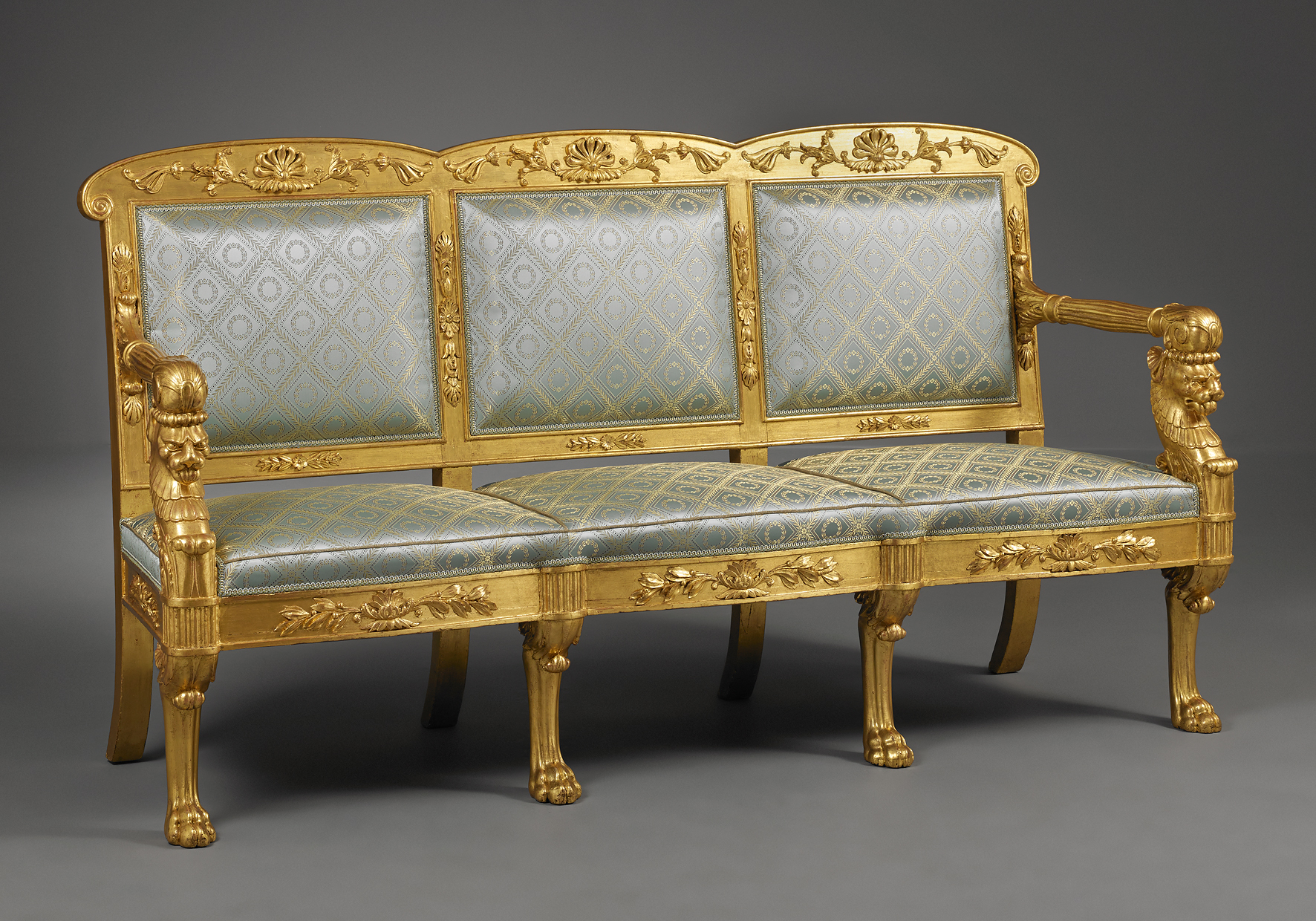

Piemontese ensemble of two armchairs and two sofas
An impressive and beautifully carved ensemble of two armchairs and two sofas designed by Filippo Pelagio Palagi and executed by furniture maker Gabriele Capello “Moncalvo”.
The front legs (two on each armchair and four on each three-seat sofa) in the shape of lions-paw feet; the back legs of sabre form. At the height of the seating rail, the legs are enveloped in acanthus leaves and restricted by a fluted band. On the part above the seating rail a lion’s head emerges from the leaves. On top of the lions head a rolled piece of textile attached to what seems to be a breast plate of Egyptian inspiration supports the front part of the armrests in the form of a rolled palmette. The fluted armrests are attached to the back of both chairs and sofas in a wealth of foliate ornament and palmettes.The carving on both seating rails and the upper part of the back shows a variation of rosettes, laurel and acanthus leaves and highly stylised flowers as well as palmettes.The back posts between the seats of the sofa show oval rosettes flanked by palmettes.
Filippo Pelagio Palagi (Bologna 1775 – Turin 1860).
Pelagio Palagi was a painter and sculptor with a great passion for the architecture of classical antiquity. In 1806 he moved to Rome and worked together with Antonio Canova, who then was president of the Academia Italiana. The time spent in Rome helped deepen Palagi’s interest in Egyptian, Greek and Roman archaeology. In 1815 he moved to Milan where he worked mainly as a painter, but by 1819 he was employed by the owners of the villa Tittoni Traversi in the renovation of both exterior and interior of the house. From then on, Pelagio Palagi worked mainly as an architect and designer.
His fame reached the Savoy court and in 1832 Carlo Alberto of Savoy-Carignano, King of Sardinia, asked Palagi to take on the renovation project of the interiors of both Palazzo Raconnigi close to Turin and the Palazzo Reale in the city itself. King Carlo Alberto entrusted Palagi with the updating of both interior and furniture so the splendour of the Savoy palaces would be comparable to that of the other European courts.
“Updating”, of course, meant introducing the Empire style, which by 1830 was already slightly out of date but, for a young king, was still a most suitable style to impress with. The king made an enlightened choice when he invited Palagi to take on the renovation, for Palagi’s knowledge of Egyptian, Greek, Etruscan and Roman antiquity’s architecture and design was profound. In his designs Palagi was able to maintain the fairly strict forms of the Empire style (based on the French Empire style introduced by Percier and Fontaine), but to interpret and vary the decorations in an inventive and eclectic way.
The decoration of the sofa’s and the armchairs is typical of Palagis exuberant designs with motifs like the rather “fleshy” monoped lion, the foliage and the variation in the stylised anthemions or palmettes. The present palmettes show both Greek and Egyptian influence, while the monoped lion is a motif derived directly from a bas-relief that Palagi undoubtedly saw when studying in Rome. He used the lion in furniture for the Palazzo Racconigi (see Antonetto 2004, Catalogo, plate 50-51).
The furniture maker who executed most of Pelagio Palagis designs was Gabriele Capello, nicknamed “Moncalvo” (1806-1877).
Moncalvo knew how to interpret and execute Palagi’s designs and the close cooperation of the two men on projects both for the Savoy court and other patrons has greatly contributed to the fame of Piemontese furniture after 1830.
Capello, both trained in menuiserie (furniture making and carving) and ébénisterie (furniture making with inlays of various woods) was one of the best furniture makers of his time and a shrewd businessman. At the start of his career he owned a small workshop but in the course of the 19th century he developed this small business into a furniture factory with some 130 workers. He realised full well that machines would form an inevitable necessity in the future furniture making industry. However, in 1832 this was not yet the case.
The first 20 years of Capello’s career, Pelagio Palagi determined the style in which Capello worked, mainly for the court and this of course had its influence on work for private patrons. Because Capello’s work bears no signature and private archives are mostly inaccessible, it is never with absolute certainty that we can attribute certain pieces to this furniture maker, but on stylistic grounds we may be fairly certain.
From the early years of the 19th century the Piemontese furniture makers found themselves in a stylistic limbo, because the French Empire style was considered to be very decadent. This changed dramatically when king Carlo Alberto decided to renovate the interiors of his residencies. The Empire style in Piemonte took on a new zeal and found its greatest designer in Pelagio Palagi and its best furniture maker in Gabriele Capello “Moncalvo”.
Sofas: Height 10 cm; Width 190 cm; Depth 55 cm.
Armchairs: Height 100 cm; Width 70 cm; Depth 55 cm.
- Period
- ca. 1835
- Material
- carved giltwoord
- Dimensions
- 100 x 190 x 55 cm
Global shipping available
You might also like