Brabant Renaissance low five-door cabinet

Brabant Renaissance low five-door cabinet
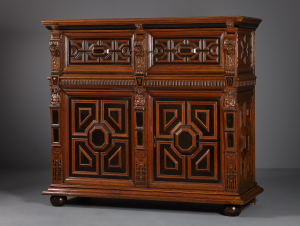
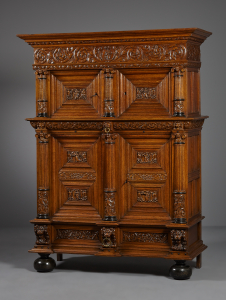
Although constructed as a single unit, this cabinet visually appears to consist of an upper and lower section. The upper section is articulated by four vertical, baluster-shaped stiles, decorated with portraits. These stiles extend into the narrow gadrooned frieze, and serve to separate the three upper doors. The lower section, similarly crowned with gadrooned moulding, is divided in two by three flat pilasters that broaden towards the top, decorated with floral carvings and crowned with a seashell. The pilasters separate the two lower doors and extend into the cabinet’s plain feet. The five doors are set with simple panels. The gadrooned mouldings continue across the sides of the cabinet, which are divided into four flat panels arranged into a cross formation.
What we know suggests that Brabant cabinets were primarily produced by monks and used in monasteries. These are sober pieces, with simple decorative schemes and constructions focused on practical convenience. Their shape is reminiscent of the far better-known Zeeland cabinet, but Brabant cabinets tend to be much more austere and are constructed as a single whole, unlike their counterparts from Zeeland.
Literature:
Loek van Aalst en Annigje Hofstede, Noord-Nederlandse meubelen, van renaissance tot vroege barok 1550-1670, 2011, p. 181-190
- Period
- ca. 1620
- Material
- sculpted oak
- Dimensions
- 120 x 177 x 66 cm
Global shipping available
You might also like