Pair of French Louis XVI fauteuils


Pair of French Louis XVI fauteuils
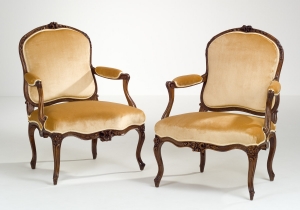
A pair of French gilt wood fauteuils with medallion-shaped backrests and elaborate carvings. The fluted legs terminate in blocks with rosettes that connect the legs with the seat and arms. The base of each arm is decorated with an erect palmette, while the medallion-shaped backrest is decorated with an elegant bow.
Louis Delanois (1731-1792)
Louis Delanois was a skilled craftsman whose legacy comprises countless chairs, in both the Louis XV and Louis XVI styles. He began in a modest workshop on Rue Bourbon-Villeneuve, but soon rose to success and set up shop at the Rue des Petits-Carreaux, where he traded in wood in addition to his primary activities. He was admitted to the guild as a master in 1761. Delanois worked for merchants, but also for the Count of Artois, the Prince of Condé, the Duke of Chartres, King Stanislaus II of Poland, wealthy collectors and, above all, Countess du Barry, who placed substantial orders with him. His reputation spread abroad, where correspondents secured lucrative markets for him, especially in Saint Petersburg. Most of the resultant orders are meticulously recorded in his Livre des ouvrages et des fournitures de meubles faits à crédit (ledger of works and furniture supplied on credit), which is preserved in the Parisian archives. This document demonstrates not only the scope and significance of Delanois’s activities, but also his incessant quest for innovative shapes and designs.
Most of his seating furniture pieces were executed in the Louis XV style, characterised by designs that are both elegant and powerful, with a fine feeling for detail. Although he continued to produce Louis XV chairs for many years, he was among the early innovators who gave rise to the Louis XVI style. Although some of his designs still had armrests or cabriole legs and therefore fell under the transitional style, most pieces clearly reflect the new, “modern” taste, as is the case with the fauteuils described here.
Though Delanois’s Louis XVI chairs are outnumbered by his Louis XV models, they are also more elaborately ornamented. Most appear to have been produced on commission. We know of a number of chairs with frames from the estate of Countess du Barry in Louveciennes; highly typical of the early Louis XVI style, they feature shield-shaped backrests, round seats and tapering legs with spiralling fluting. Two such chairs, formerly part of the Polès collection and acquired by Mr Lopez-Willshaw, were displayed at the exhibition Grands Ebénistes et Menuisiers Parisiens (Great Parisian Cabinetmakers and Chairmakers) in the Musée des arts Decoratifs, in 1955-1956 (no. 74) before being offered for sale in 1980. Another chair was sold in New York in 1984. Three further examples were housed in Berlin’s Kunstgewerbemuseum before World War II. The screen that completes this set is owned by the Louvre.
Literature:
Pierre Kjellberg Le Mobilier Français du XVIIIème Siècle", p. 265-270
- Provenance
- Auktionshaus Schloss Ricklingen, 1980
Private collection, Germany - Period
- ca. 1775
- Material
- Carved giltwood
- Signature
- L Delanois
- Dimensions
- 95 cm
Global shipping available
You might also like