Dutch Renaissance two-door cupboard

Dutch Renaissance two-door cupboard
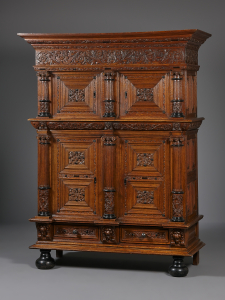
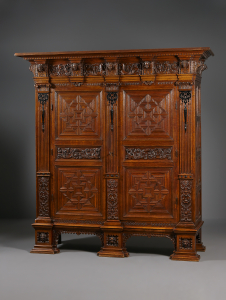
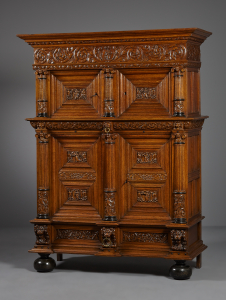
An early Dutch Renaissance two-door cabinet, comprising three sections. This model stands atop a separate base containing two drawers, above which are set two doors flanked by flat, fluted columns. These, in turn, are crowned with a richly ornamented upper section featuring nine finely carved lion masks and portrait busts. Surmounting said carvings is a rich array of mouldings, including braided bands (known as geteld geld, lit. “counted money”), crenellations, egg-and-dart mouldings, and block mouldings. The date 1618 is marked beneath the first portrait bust on the right side of the cabinet.
The large doors are set with four clusters of five geometrically arranged panels. These smooth panels on the cabinet’s face are all inlaid with exuberant floral patterns – a rare feature for furniture from North Holland. This form of ornamentation was likely introduced from the Southern Netherlands, where it was much more common.
Cabinets such as this, constructed with two large doors and on an imposingly large scale, are characteristic of early Dutch furniture from the first quarter of the seventeenth century.
Literature:
Afgebeeld in: Loek van Aalst en Annigje Hofstede, Noord-Nederlandse meubelen, van renaissance tot vroege barok 1550-1670, 2011, p. 67
- Provenance
- Van Aalst Antiquairs, Breda, ca. 1995
Private collection, Belgium - Period
- 1618
- Material
- oak, moor oak, ebony
- Dimensions
- 236 x 188 x 70 cm
Global shipping available
You might also like