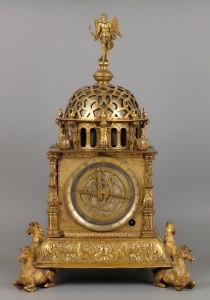
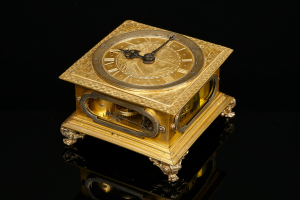
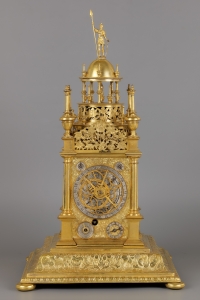
Dutch brass pocket sundial, Anthony Hoevenaar

Dutch brass pocket sundial, Anthony Hoevenaar
Anthony Hoevenaar, an instrument and watchmaker, was born in Rotterdam in 1630 as the son of Pieter Hoevenaar and Sibilla Sneewins, and passed away on 15 October 1695 in Leiden, having last resided on Rapenburg. In 1654, he was recorded as being an instrument maker.
A deed from 22 July 1655 noted the following:
“Anthony Hoevenaer, maker of mathematical instruments and watches, residing on Kloksteeg, declares to take as an apprentice Dirck, son of Jan Jansz. de Block. He must take him in that capacity for the duration of six years, and Dirck de Block must pay six silver spoons or a silver salt cellar. The last two years, De Block shall have one free hour a day to spend on the learning of any Arts.” As a watch and instrument maker, Anthony set up his store and workshop in a building on the corner of Rapenburg and Kloksteeg in Leiden, now Café Barrera.
Evidence suggests that he was a very skilled instrument maker, an aptitude that he seems to have inherited through his mother, who had three brothers - Anthony, Henricus and Johannes Sneewins - all three of whom were skilled instrument makers as well. Anthony Sneewins had a son, Willem, who was a watchmaker on Buitenwatersloot in Delft.
On 25 March 1683, Anthony Hoevenaar was entered in Leiden University’s Album Studiosorum as follows: “Antonius Hoevenaer, Di Profis Volderi amanuensis quod ad instrumenta mathem”.
As Professor De Volder was the first to establish a collection of physics instruments for the Faculty, we may assume that Anthony was the first physics instrument maker affiliated with Leiden University, unless Samuel van Musschenbroek already held such a position. Uffenbach, who visited Leiden in 1711, noted that the base of the large quadrant in the observatory (attributed to W.J. Blaeu by Vossius) bore a brass plaque with the inscription Antonius Hoevenaer fecit Leidae, from which he concluded that Anthony had only been commissioned to mount the quadrant. Uffenbach did praise him as a skilled instrument maker, however.
A number of instruments by Anthony’s hand survive. It should be noted that Anthony did not trade in only his own products; for instance, in an advertisement in the Leidsche Courant of 8 December 1692, he offered for sale “a geometric instrument with its appurtenances for the excellent measuring of minutes, as well as various other instruments crafted by Jacobus de Steur tot Leiden.”
After his death, an estate inventory was drawn up, which among others noted that “Anthony’s room contains several objects from the shop, a number of watches and parts thereof, such as outer casings, mechanical assemblies with so-called balances, a moon phase indicator and minute hand and some chainwork. In the shop and the workshop are two clocks and a series of instruments, which include astrolabes, perspective instruments, and small measuring tools, as well as a single proportional compass with thirteen scale strips by Gottman. In terms of tools, we find there a lathe, anvil, screws, as well as saws, pliers, planes, a drill, chisels, rules, framing squares, compasses and various wooden templates.”
Instruments by Anthony Hoevenaar are found in museums including the Musée National de Marine in Paris, Museum Boerhave in Leiden, and Port-Louis Naval Museum in Brest.
- Provenance
- Mario Crijns, Breda
Private collection, Breda - Period
- ca. 1675
- Material
- iron and brass
- Signature
- A. Hoevenaer Leyde
- Diameter
- 5.80 cm
Global shipping available
You might also like