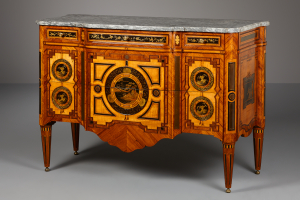
Dutch Louis XVI Ensemble, Consisting of a Commode and four Corner Cabinets
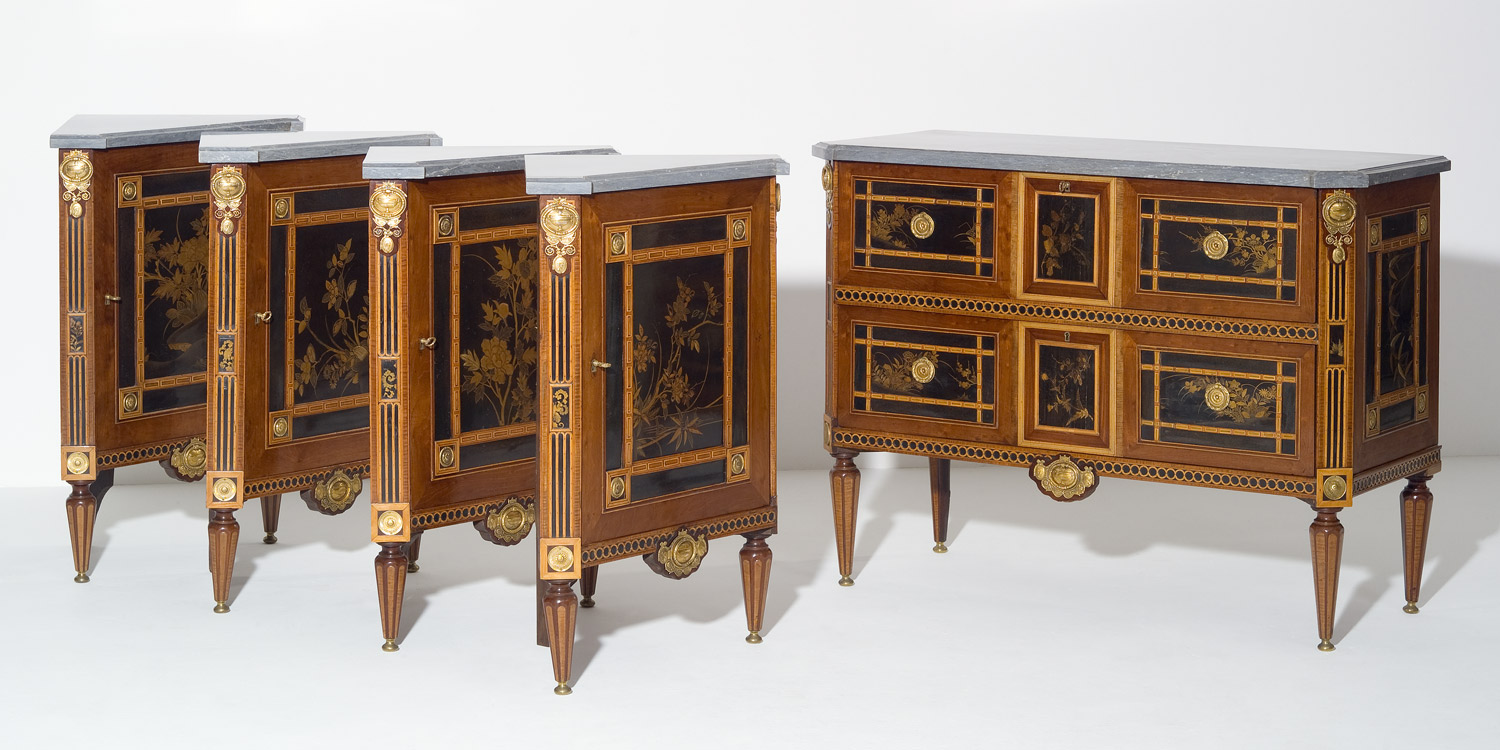


Dutch Louis XVI Ensemble, Consisting of a Commode and four Corner Cabinets
The commode stands upon tapering legs with brass buttons. The legs are decorated with eight sycamore gadroons, endowing the legs with a somewhat octagonal shape. The front stiles have been fitted at an angle and are decorated with cannelures above the base. In the middle of each stile, between the cannelures, is a small lacquerwork panel. The base of each stile is decorated with rosette-shaped bronzework; further bronzework adorns the top. Like the bronzework on the skirt, this bronzework has been set upon mahogany plates for emphasis.
The commode has two drawers, each decorated with three lacquerwork panels. The outer two are in landscape orientation and framed with bands of bamboo, in turn surrounded by solid black panels. In the centre of the lacquerwork panels are rosette-shaped drawer pulls. The middle panel is in portrait orientation and framed with boxwood borders. The keyhole is located in the upper side of the frame, outlined with a thin brass edge to protect the wood. The bottom rails on the front and sides are decorated with a band of interlocking circles, as is the central rail on the front.
The sides of the commode are decorated with large lacquerwork panels framed in bamboo bands and black panels. The frames are decorated with rosette-shaped bronzework at the corners.
The lacquerwork panels are affixed to the wood core on the sides by means of an ingenious click connection system, allowing them to be removed as a whole, frame and all.
The encoignures.
The four encoignures, each containing a single interior shelf, are decorated in a manner similar to the commode. The lockable doors are each decorated with a large lacquerwork panel. The inner side of each door is fitted with a slider that, when pulled up, makes it possible to remove the lacquerwork panels, but not their frames.
The surface of the exteriors of both commode and encoignures suggest a strong sense of motion and plasticity, as a result of which these items make a very rich impression.
This rare ensemble of commode and matching encoignures may be the work of Matthijs Horrix (1735-1809), a cabinetmaker from The Hague, but the absence of a signature means that this cannot be determined with certainty. The bamboo bands around the lacquerwork panels and the shape of the legs show a strong kinship with other items of furniture whose attribution to Horrix has been definitively established.
The fact that a number of the panels are removable may have to do with the summer and winter decoration schemes of the room for which they were built. The fabric decorations of rooms were changed every six months. In the summer, light and airy curtains would be put up, and the chairs fitted with loose covers made from the same fabric. In the winter, the windows and doors were covered with heavier, warmer curtains (portières) and the covers on the chairs were removed.
It is not inconceivable that this ensemble originally included a second set of panels covered in light, summery fabric.
Encoignures were produced in large numbers during the eighteenth century, undoubtedly fuelled by the preference at the time for rooms with unique, rounded shapes. After all, encoignures could alter the shape of a room from a square into a polygon, at least optically.
The ensemble may have been commissioned for a lacquerwork or Oriental cabinet, whose walls would have been covered with hand-painted paper or fabric wallpaper befitting the collection of Oriental trinkets on display.
Measurements:
commode: Height 96,5; Length 125 cm; Width 55 cm
encoignures: Height 96,5; Length 69 cm; Width 41 cm
- Provenance
- Auction Hans W. Lange, Berlin 3-4 december 1940, Lot, 339, 349 and 341 (illustrated)
Collection Salomon Stodel Antiquités, Amsterdam 2000 - Period
- ca. 1780
- Material
- oak frame veneered with mahogany, sycamore, buxuswood and bois tentée. Japanese lacquered panels.
- Dimensions
- 96 x 55 x 125 cm
Global shipping available
You might also like